
NOD
Initializing
🎵
25:00
0:00
🔍Listen1
💛Empathy2
🤝Trust3
Collab4
Local
Resume
Pinned
Pin tools with ☆
Recent
Fresh start
Deck: 0
Used: 0
Round: 0
ID:
STALLING FOR TIME 10 min
10:00
Promoted 📚 Field Manual — 33 chapters, every tool scripted. Unlock $49 →
Past
What's been said
The history, their position, what brought you here. Every objection they've raised. Every concession they've made. You've already done the hard part — you showed up.
Present
What's on the table
Right now, this moment. What's being said. What's not being said. The tension holds the answer — stay in it, don't rush past it. Listen for what changes the frame.
Upcoming
Where you're steering
Your next calibrated question. The label that shifts the room. The close you're walking toward — not forcing, walking toward. One move at a time.
▶ Current Tool

🇻‍🏳 Label Maker

0 ready
No labels yet
🧠 CALMAR — Mindset Before You Speak tap to expand
CCuriosity
Go in expecting to learn. Curiosity is an emotional shield — you can't be angry and curious at the same time. Ask yourself: why did they just say that?
AAcceptance
Accept you'll be attacked. It won't make sense. It comes with the territory. Figure out which of three reasons: self-protection, you-don't-get-it, or manipulation.
LLet it out
Dump your bucket to a trusted, uninvolved person BEFORE the conversation. Clear the carbon out of your cylinders so negative emotions don't surface mid-negotiation.
MMap the types
Identify their negotiator type (Assertive, Analyst, Accommodator) AND your own. Each type values something above making a deal — know what it is.
AAccusation Audit
Name every negative they could think about you before they do. Go for the hardest ones. If it feels like too much, you're not going far enough. Don't step on it with a “but.”
RRecognition
Your counterpart is not the issue — the problem is. Turn them into a teammate in a problem-solving venture. It's not about you.

🎯 Minimum of Operation

0/0
🌼 Emotion Check Tap a wedge
📋 Session Log
No tools used yet.

🌼 The Wheel Is Right

7 core emotions · 126 words · spin, listen, then name what landed

Loading emotion wheel…

👈 Drag wheel or tap SPIN

Tap any emotion to focus
Names only

💰 HAGGLE MODE

— scenarios · flinch, anchor, fairness frame. Deal one card at a time.

Deal:
Moves: 0
Phase: Open
🧮 Ackerman Ladder

🏷️ Haggle Labels

0 ready
Tap Generate to make haggle labels ✨
DEAL CLOCK 10min
00:00
🌼 Emotion Check TAP A WEDGE
📋 Tactics Checklist Responder mode — tap each tactic as you hear it. 0/8

🤝 FRIEND MODE

— scenarios · liking, reciprocity, unity, social proof. Deal one card at a time.

Scene:
Moves: 0
Phase: Meet

🏷️ Connection Labels

0 ready
Tap Generate to make labels ✨
CONNECTION CLOCK 10min
00:00
🌼 Emotion Check TAP A WEDGE
📋 Tactics Checklist Responder mode — tap each tactic as you hear it. 0/8

👔 BOSS MODE

— scenarios · managing up — BATNA, label, reframe, accusation audit. Deal one card at a time.

Scene:
Moves: 0
Phase: Prep

🏷️ Power Labels

0 ready
Tap Generate to make labels ✨
MEETING CLOCK 10min
00:00
🌼 Emotion Check TAP A WEDGE
📋 Tactics Checklist Responder mode — tap each tactic as you hear it. 0/8

⚖️ MEDIATOR MODE

23 scenarios · de-escalate, label, reframe, caucus, reality-test. Deal one card at a time.

Scene:
Moves: 0
Phase: Plan

🏷️ De-escalation Labels

0 ready
Tap Generate to make labels ✨
SESSION CLOCK 10min
00:00
🌼 Emotion Check TAP A WEDGE
📋 Tactics Checklist Responder mode — tap each tactic as you hear it. 0/8

💰 SALES POWER

Sales is elicitation. The same skills you use to negotiate — listen, label, ask calibrated questions — are how you sell without pushing.

LIVE FEED // Closer's Desk

The Deals Land When You Stop Chasing

Ask, investigate, let them persuade themselves — and the money finds the desk.

💵 NEW DEAL CLOSED
Old model salespeople present, convince, and chase. New Model salespeople ask, investigate, and let the prospect persuade themselves.
❌ Old Model
Pitch on the first call. Tell them how great the product is. Push for the appointment. Trial close. Chase voicemail.
✅ New Model
Find out what they're looking for and why. See if you can even help. Let them tell themselves why they responded.
📍Listen1
🔍Situation2
⚠️Problem3
💡Solution4
📉Consequence5
🎯Qualifying6
🤝Commit7
Tap a stage to see the questions and flow for that step.
Sales skill
Connecting Questions
Situation Questions
Problem Awareness
Staying neutral
Negotiation twin
Calibrated Questions
Information gathering
Labeling the problem
Dynamic Silence
Sales is the first half of negotiation. You can't negotiate until you've elicited what they actually want — and why.

💬 Sales Maker

0 ready
All stages · Tap a stage above to focus questions
Tap Generate to get two sales questions ✨

📝 Prospect Notes

0 saved
Local tracking active · sign in to sync progress
No prospect notes yet.

🏆 YOUR FIRST $200M

Dan Peña's Quantum Leap Advantage (QLA) — the 11-step deal-making system that built a trillion dollars in equity. One sure-footed step at a time.

High performance people take action quickly and change their minds slowly. You can leapfrog to Quantum success — but you still have to do the deals one sure-footed step at a time.
Yesterday's dreams are today's realities
See your dreams ahead of time
Simulate: practice within when without
Act as if there are no limits
Enthusiasm = "god within"
💡Identify1
🔍Investigate2
🔬Specifics3
🔥Commit4
⚖️Pre-Decision5
📡Re-Investigate6
📋Action Plan7
🛤️Critical Path8
📞Follow Up9
💥Execute10
🔄Re-Evaluate11
Tap a step to see Dan Peña's actions for that phase.
01 FOUNDATION
Read Your First 100 Million, Think and Grow Rich, Release Your Brakes. Build the knowledge base.
02 VISION
Set bodacious goals. Dream big enough to change how you act, decide, and execute.
03 PERCEPTION
Perception is reality. Position yourself at the level you're building toward. Execute until it becomes fact.
04 DREAM TEAM
Surround yourself with high-performance people. Get everyone obsessed and committed publicly.
05 ACTION PLAN
Define your desired outcome. Define your pay-price-to-action. Walk your talk — never share a doubt.
06 PAY YOURSELF
Use OPM — Other People's Money. Leverage capital, experience, and relationships. Don't self-fund.
07 EXIT STRATEGY
Acquisitions are the secret of Quantum growth. Build to sell. Your grand exit is the strategy from day one.
Dan Peña's most famous mentee. Dan Lok built a $100M+ empire by applying QLA to the digital age — then teaching others to close high-ticket deals with Certainty.
PRINCIPLE 1
Stop selling, start solving. Average closers convince. Elite closers prescribe. Be the obvious solution, not another pitch.
PRINCIPLE 2
Charge for transformation, not hours. High-ticket clients pay for certainty, confidence, and fast results — not your time.
PRINCIPLE 3
Rejection is feedback, not failure. It means your value wasn't clearly communicated. Objections are opportunities, not roadblocks.
PRINCIPLE 4
State your price with certainty. Don't justify. Don't dance. State it clearly, then shut up. Silence is the closer's weapon.
PRINCIPLE 5
Maintain authority. Guide the prospect to the sale — never let them take control of the conversation.
"Building Certainty in an Uncertain World. I build with Certainty." — Dan Lok
$820
Starting investment that became a $400M company (Great Western Resources)
86×
Times Dan was told "you cannot do that" — and did it anyway
YCDT
"You Can Do That" — the philosophy that separates real risk from fear disguised as advice
5
Credos that turn abstract philosophy into daily operating behaviour
"There are always enough reasons to do nothing. QLA is about refusing to let conventional wisdom make that decision for you." — Dan Peña
Investigate before you invest. Find out every detail on the who, what, when, where, and how.   One red flag = exit immediately. The tiniest wrinkle in the fabric can explode in your face later.   Doofus Test: Are they willing to pay the price? Schedule meetings at night, weekends, holidays, birthdays.   Stick to your knitting. Deploy assets where you have the greatest probability of geometric success.   Laser-beam focus. Distraction is the only luxury of poor people.
SUCCESS TEST
Are you willing to pay the price? What have you sacrificed to get where you are — and what are you willing to give up to get where you want to go?
SNOWFLAKE TEST
Can you handle pressure without melting? Are you tough enough to take the heat when the deal gets hard — or do you crumble at the first objection?
SUPER SUCCESS TEST
Do you have the obsession? Not interest — obsession. Are you willing to alienate yourself from everything not connected to your Quantum Leap?
"QLA is not a journey. It is a process." — Dan Peña
Dan Cruz character
Progress over punishment

💪 NOD FITNESS

Beginner-friendly pull-ups, dips, and jump rope for people over 30. Log the small wins — saved on this device and synced to your account.

Local tracking active · sign in to sync progress
No ego check

Today's starting point

0 First week
Begin with hangs and rows. Strict reps can wait.
Pick one thing

Beginner block

Pull-ups

Start with hangs, rows, and assisted reps before strict pull-ups.

    See it move

    Drill visualizer

    Select drill

    FORM · 2.5s cycle PROGRESS OVER PUNISHMENT HANG → ROW → REPS 0 reps
    FORM · 2.5s cycle SHALLOW BEFORE DEEP INCLINE → SUPPORT 0 reps
    RHYTHM · 0.7s cycle ROPE LOCKED NO-ROPE BOUNCE 0 sec
    20-MIN TIER UNLOCKED

    Earn the rope at 50+ jump-rope reps. Log your reps above and the figure unlocks the line.

    Recovery included

    First week you can repeat

    0% complete
    Progress log

    Save today's work

    5/10
    Local + Supabase

    Recent progress

    No sessions yet.
    PS5 HUD // High-Stress Combat Conditioning

    Combat Movement & Composure

    Train your physical nervous system to maintain laser composure, slip counter-pressure, and execute under heavy fire.
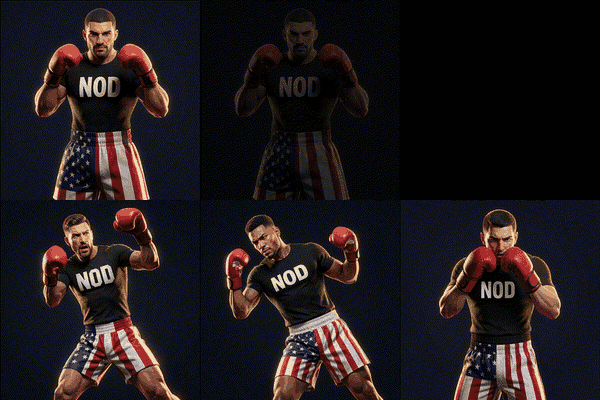
    NOD boxer practicing combat movement drills
    EVASIVE REACTION: 110ms
    CADENCE: SLIP & COUNTER
    162 BPM
    Slip & Counter Protocol STATUS: READY

    Train high-speed bobbing, weaving, and angle shifts. When opposing negotiators throw hostile pressure, you slip the attack and counter with calibrated questions.

    REACTION VELOCITY 98% OPTIMAL

    When in doubt, label it out

    🥊 Jab = Mirror Quick repeat of their last 1-3 words. Opens the round.
    🥊 Right = Label Name the emotion. "It sounds like you're worried about..."
    🥊 Uppercut = Accusation Audit Pre-empt the worst they could say. Defuse before they swing.
    🥊 Slip = Calibrated Question "How am I supposed to do that?" Dodge, redirect, let them solve it.
    🥊 Counter = Summary Stack their own words back. "That's right" = knockout.
    🥊 Guard = Dynamic Silence Say nothing. Let the silence do the work. Composure under fire.
    Sand glass focus

    ⏳ NOD POMODORO

    One calm block. Then a real break.

    Current round

    Focus

    0 blocks today
    25:00
    Sand tray Drop or skim this round
    Flow

    Today's rhythm

    0blocks
    0focus min
    Short breaknext
    Done

    Recent blocks

    No focus blocks yet.

    🧲 PERSUASION

    Cialdini's 7 principles of influence + the art of pre-suasion. Direct their attention before you deliver the message. The most powerful persuasion happens before they know you're persuading.

    Influence isn't about what you say — it's about what they're thinking about when you say it. Capture attention first, then deliver. The "privileged moment" before the ask is where persuasion lives.
    Tap a principle to see how to deploy it — and how to use it in a negotiation.
    1
    Pre-Suade
    Capture attention. Plant the association. Make them receptive before the message.
    2
    Connect
    Liking + Reciprocity + Unity. Build rapport. Give first. Find shared identity.
    3
    Reduce Risk
    Authority + Social Proof. Expertise and consensus lower the threshold to say yes.
    4
    Motivate Action
    Consistency + Scarcity. Lock the commitment. Make inaction feel like a loss.
    The best persuaders don't argue. They arrange for the other person to persuade themselves.
    PS5 HUD // Influence Engine

    The Persuasion Operating System

    7 principles, deployed in sequence. The orb charges as you stack them — full power means they persuade themselves.

    Influence orb charging
    INFLUENCE CHARGE
    0 / 7

    Tap to charge the orb

    🔍 LISTEN FOR

    What do I listen for? Seven hidden categories of information. Discover each before you attempt to persuade. Listen → Understand → Influence

    🧠 CALMAR — Mindset Before You Listen tap to expand
    CCuriosity
    Stay curious to find the latent dynamic beneath the presenting one. There's always something underneath — curiosity is how you find it.
    AAcceptance
    Attacks come in three flavors: self-protection, you-don't-get-it, or manipulation. Identify which one before you respond. Stay in the moment.
    LLet it out
    Clear your head before you listen. Vent to someone detached so your own emotions don't filter what you hear.
    MMap the types
    Know their type and yours. Analysts process data; Accommodators protect relationships; Assertives want to be heard. Listen for the type.
    AAccusation Audit
    Defuse the negatives before you listen. If they're sitting on a negative you haven't named, it's filtering everything they say.
    RRecognition
    They're not the issue — the problem is. Listen as a teammate, not an adversary. Turn the dynamic from confrontation to collaboration.

    ⚙ SETTINGS

    Customize your NOD-ify experience

    🌼 Emotion Wheel
    Wheel behavior
    Spin mode: drag wheel or tap SPIN to randomize.
    🃏 Tool Cards
    How many tools to show
    Medium: core tools across all categories.
    🎨 Visuals
    📚 33-Chapter Reference Deck
    Full tactical reference cards with every tool, script, and scenario.
    📕 Unlock with Field Manual — $49

    🧠 PREPARATION

    Before you enter the conversation — fill your one-sheet.

    Based on Never Split the Difference — Negotiation One-Sheet
    0 of 19 — tap each item as you prepare
    ⚡ The 6:1 Prep Ratio
    6 Accusation Audits · 5 Asking Labels · 4 What Questions · 3 How Questions · 2 No-Oriented Qs · 1 Why (proof of life) · 1 Summary
    Minimum counts per skill. Go longer on audits — you probably don't have enough.
    Goal
    Define your best-case scenario — optimistic but reasonable. Stay open to something better.
    Identify the specific scenario that represents best case.
    Set an optimistic but reasonable goal and define it clearly.
    Write it down.
    Discuss your goal with a colleague — creates commitment and consistency.
    Carry the written goal into the negotiation.
    Don't be so specific on the end result that you miss something better. Hold your goal loosely — you set it with incomplete information. Have more than one goal in mind.
    🔴 Black Swan Hunt
    Goal: find 3–5 pieces of information that could change everything.
    Goal: get them to tell you things they'd never tell anyone else.
    Summary
    A couple of sentences about the known facts that led up to the negotiation. Intended to produce a “that’s right” response.
    Accusation Audit 0/6
    Name every negative they could think about you before they do. Six is the minimum — you probably need more. Don't justify, don't explain, just name them and let them sit.
    You probably think I'm
    It might seem like I don't
    You might feel I'm
    It probably seems like I
    You may think I'm
    It probably seems like
    Go for the hardest ones. If it feels like too much, you're not going far enough. Pause after each one — don't step on it with a “but.”
    Two ways it ends: (1) They interrupt to say “you're being too hard on yourself” — ideal. (2) You exhaust your list and simply stop talking. If met with silence, you haven't gone far enough — keep going.
    Calibrated Questions 0/7
    4 “What” questions uncover problems. 3 “How” questions address implementation. Never Why — that goes in Proof of Life below.
    What Questions — uncover problems 0/4
    What are we trying to accomplish?
    What’s the core issue here?
    What is the biggest challenge you face?
    What happens if you do nothing?
    How Questions — implementation 0/3
    How is that worthwhile?
    How does this fit into what the objective is?
    How does making a deal with us affect things?
    Behind-the-table deal killers
    How does this affect the rest of your team?
    How on board are the people not on this call?
    What do your colleagues see as their main challenges in this area?
    Label every answer. Never answer a question at face value — say “What makes you ask?” or hit it with a label from your go-to list.
    ④b
    No-Oriented Questions 0/2
    Frame it so “no” is the safe answer. The truth comes right after their no. Keep each under 10 words.
    Pick two — or write your own
    Is now a bad time to talk?
    Would it be ridiculous to explore another option?
    Have you given up on getting a fair deal?
    Is it a bad idea to look at alternatives?
    Would it be unreasonable to ask you directly?
    ④c
    Proof of Life — The One Why 0/1
    The only time “Why” is allowed in negotiation: verifying the counterpart can actually deliver. Ask it once, carefully.
    Verify execution capacity
    Why would your team agree to this when you’re not in the room?
    Use “Why” only to confirm they can execute. Never as a challenge — it triggers defensiveness.
    Asking Labels 0/5
    Labels used as questions. Two-thirds of people dislike direct questions — a label provokes a less defensive response. Aim for five.
    It seems like
    It sounds like you've
    It seems like
    It sounds like
    It seems like there's
    Label the answer to every calibrated question — every time, no matter how they answer.
    Non-Cash Offers
    List non-cash items your counterpart possesses that would be valuable to you. What could they give you that would make you do this for free?
    🛡️
    One-sheet ready. You’re prepared.
    The most powerful move in any conversation happens before it starts. Fill your one-sheet — your goal, your labels, your questions — before you open your mouth.
    🚩 Red Flags from the Counterpart 10 phrases that reveal a hidden negotiation — tap to expand

    “The most dangerous negotiation is the one you don’t know you’re in.” Any communication in which you want agreement, influence, action, referrals, or satisfaction is a negotiation. When you hear these phrases, you’re already in one — the commodities at stake are information, time, money, cooperation, and your happiness.

    Leadership — Action = Implementation
    Communication to guide action. Disagreement about action is a hidden negotiation.
    “We have to …”
    Means Someone is pushing a specific action — and likely expects pushback.
    Your move Summarize the problem three-dimensionally: what happened, the impact (include the negative effects on them), and what you’re worried about.
    “We should …”
    Means The “should” trap — a negotiation about action. Someone is disagreeing about what is or isn’t being done.
    Your move Label the disagreement: “It seems like you see a different path to the goal.”
    “You should …”
    Means A directive dressed as advice — they want you to own the action.
    Your move Calibrated question: “How does that fit into what we’re trying to accomplish?”
    “I need you to …”
    Means A demand framed as a personal need — the relationship is being leveraged.
    Your move “How am I supposed to do that?” — hands the problem back without saying no.
    “Here’s what we need to do …”
    Means A unilateral plan — collaboration hasn’t started, it’s being declared.
    Your move “What are we trying to accomplish?” — re-anchor on the objective before debating the how.
    “I think …”
    Means An opinion offered as a soft position — testing for agreement.
    Your move Mirror the key noun, then pause. Let them elaborate before you respond.
    Teamwork — Seeking Collaboration
    Trying to discover what action should be taken. Information-gathering is influence.
    “Let’s think about this …”
    Means An invitation to collaborate — or a stall to reframe the problem on their terms.
    Your move Label: “It seems like you’ve seen this before.” — opens space for them to share.
    “How do we …?”
    Means They’re seeking a path — a genuine opening for you to shape the outcome.
    Your move “What’s the biggest challenge you face?” — surface the real obstacle before proposing.
    “What do you think …?”
    Means They want your buy-in — or they want you to commit before they do.
    Your move Label: “It seems like you have some thoughts?” — get theirs first.
    Hospitality & Customer Service
    Hoping to provide satisfaction by solving their problem and getting agreement on the outcome.
    “How can I help you?”
    Means A service opener — but you’re in a negotiation the moment you want a specific outcome.
    Your move Cold-read first: “You look [upset / tired / like it’s been a long day].” Label the negative you see to deactivate it.
    ⚠️ The “Should” Trap: Be particularly wary if the word “should” crosses anyone’s lips — yours or theirs. If you hear it, you’re in a negotiation about action.
    Source: Chris Voss — “10 Phrases That Reveal (Dangerous) Hidden Negotiations,” The Black Swan Group.
    🎯 Counterpart Scanner
    Answer 8 quick reads. We'll identify their negotiator type and hand you the playbook.
    0 of 8

    🧗 Behavioral Change Stairway

    The FBI model: move through each stage in order. Click any stage to expand its tools.

    🌿 MINDFULNESS

    Reset before the table. Tactical reset, four breathing protocols, or a guided body scan.

    Local tracking active · sign in to sync progress
    Pre-table state

    Set the reset target

    90-Second Tactical Reset

    Label the pressure, lengthen the exhale, choose the next move.

    Box Breathing

    4-4-4-4 · Focus and control

    4-7-8 Relaxation

    4-7-8 · Calm the nervous system

    Coherent Breathing

    5-5 · Balance and steady

    Extended Exhale

    4-6 · Downshift and release

    10-Min Body Scan

    Guided audio — head to toe, release tension.

    Ready
    0
    Today

    Quick journal

    Local + Supabase

    Recent progress

    No sessions yet.
    Inspired By
    Chris Voss · Never Split the Difference Derek Gaunt · Ego, Authority, Failure Jim Camp · Start With No Robert Cialdini · Influence Robert Greene · The 48 Laws of Power The Black Swan Group · Negotiation Through Emotion Gary Noesner · Stalling for Time
    NOD-ify · Built by dan cruz · © 2026
    M5.2

    🔓 Unlock the Full Deck

    You're using the free tier — 21 tools. The full deck has 31 negotiation tools, plus progress tracking and new features.

    $5/month

    Cancel anytime. Sign in required to track your progress.

    UNLOCK ALL 31 TOOLS →